
“I Know I’m Not Straight”
After spending days talking to riders at Scone and Burghley, one thing really struck me. Almost nobody sat on our demonstration horse expecting to be straight.
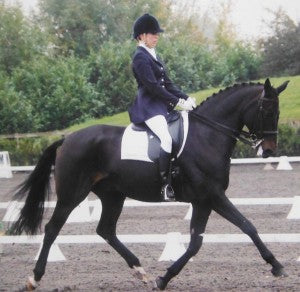
Before we'd even properly looked at them, riders would tell us why. Hip replacements, broken ankles, back injuries, damaged knees, old falls. Others simply said, “My trainer has been telling me for years that I collapse to one side.” And it got me thinking. Perhaps we need to stop treating rider asymmetry as something that needs an excuse.
Humans are naturally lateral. We have dominant hands, preferred legs and movement patterns that develop throughout our lives. Add injuries, work, sport and decades of riding and it would be surprising if our two sides behaved identically. The problem isn't simply knowing that we're asymmetrical. In fact, most riders we meet already know. The problem is changing it.
As a trainer, this is something I've struggled with for years. I can see where a rider is sitting and tell them what I see, but verbal correction doesn't necessarily address where the movement began. Imagine a rider who grips and shortens through their left side. Their pelvis and trunk respond and the left shoulder may appear lower. From the ground, the obvious instruction might be, “Lift your left shoulder.” The rider does exactly that. But have we corrected the original pattern, or have we simply added another movement on top of it?

If the base hasn't changed, deliberately lifting the shoulder can alter the trunk and loading elsewhere rather than restoring whole-body organisation. That is why I became increasingly uncomfortable correcting the part of the rider I could see without understanding what was happening underneath it.
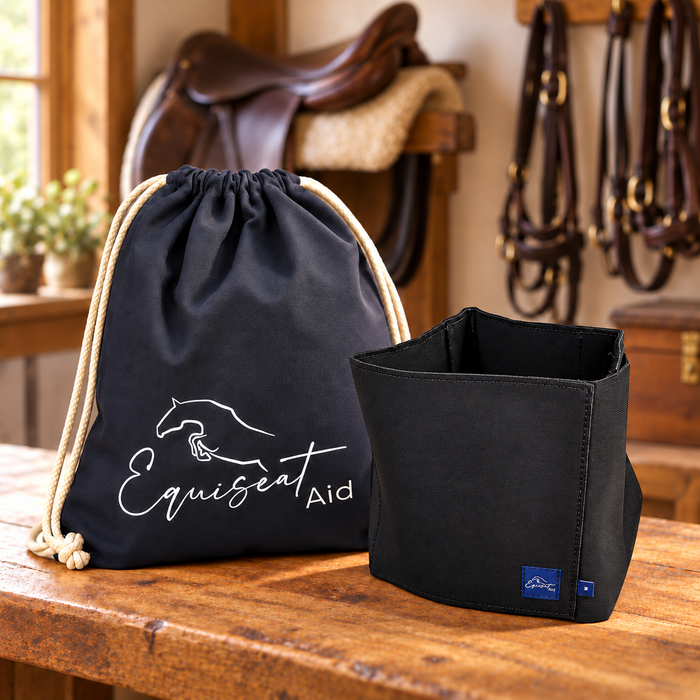
Research supports the importance of looking at the whole rider-horse system. Studies using saddle-pressure measurements have found relationships between rider asymmetry and asymmetric forces beneath the saddle. The horse doesn't know why we're sitting differently; it simply responds to the forces and movement it receives. This is really where Equiseat Aid came from. I didn't want to hold somebody in a manufactured “straight” position. I wanted to give the rider another physical reference point, so that instead of constantly being told where straight was, they had something that could help them explore a different movement pattern.
Our latest six-week ARU validation trial has now given us objective data around that idea.
Twelve horse-and-rider combinations began the study and eight completed the full six weeks. Riders were assessed both with and without Equiseat Aid at the beginning and again after six weeks of regular use. Researchers measured rider posture, force and pressure underneath the saddle, and objective movement symmetry in the horses. The saddle-pressure system found significant changes in left-right peak-force symmetry, diagonal peak-force symmetry, left-right total-force symmetry and left-right peak-pressure asymmetry between Week 1 and Week 6. Interestingly, rider identity accounted for around 69% of the variation in left-right peak-force loading, showing just how individual our loading patterns can be.
And it wasn't only the riders and saddles that changed. After six weeks, objective EquiGait measurements recorded reductions of approximately 21–30% across the horses' head and pelvic movement-asymmetry measures, alongside a 13.5% reduction in the overall locomotor-asymmetry score. That, for me, is why straightness matters. Not because being asymmetrical makes somebody a bad rider. Not because we should be embarrassed about an old injury. And certainly not because we should spend an entire lesson desperately trying to hold one shoulder higher. It matters because we sit on another moving body.
Maybe the conversation needs to change from: “Why am I crooked?” to: “What is my pattern, where does it start, and can I teach my body another way?”
After meeting so many riders at Scone and Burghley who already knew they weren't straight, I'm increasingly convinced that riders don't have an awareness problem. We have a problem turning awareness into lasting physical change.
And that is exactly the problem Equiseat Aid was created to help us explore.
