

Rider Balance and Horse Movement: New Equiseat Aid Study Results
Share
Could improving your position in the saddle help your horse move more evenly? A new Equiseat Aid study has recorded encouraging changes in both rider alignment and horse movement following six weeks of regular use.
For riders who want to support their horse through better balance, the findings offer a useful insight into the connection between how we sit and how our horses move.
Why work on your balance in the saddle?
It isn’t always easy to notice when you’re sitting unevenly. You might feel more secure on one rein, grip more with one thigh or struggle to keep your weight evenly distributed.
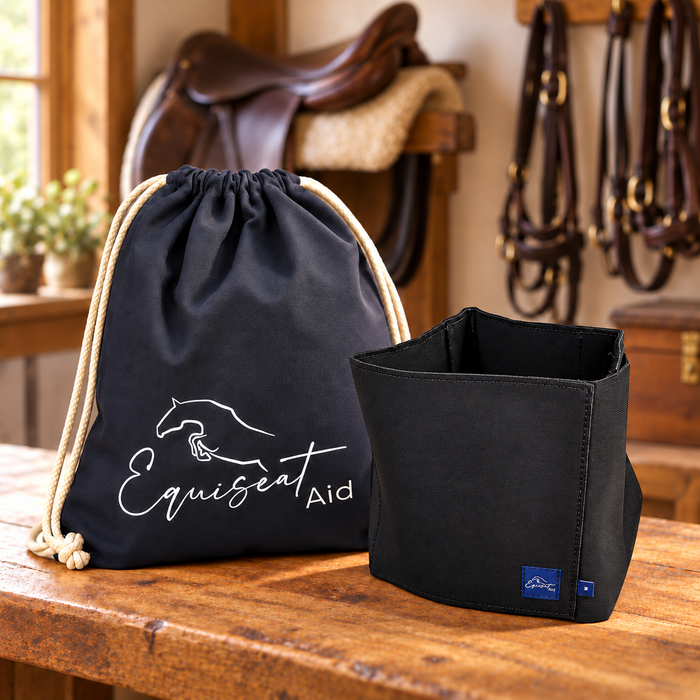
Equiseat Aid is designed to help you recognise and adjust these habits. It works through the rider, providing a physical cue to encourage a more balanced position without restraining the horse or applying pressure directly to its body.
The study explored changes across the rider, saddle and horse, rather than looking at rider posture alone.
What did the Equiseat Aid study involve?
The report was co-authored by Prof Roberta Blake, Sonia Domenech Sadurni, Charlotte Gregory and Izzy Taylor of ARU Writtle, together with Dr David Marlin. The final report was completed in August 2026.
Twelve horse-and-rider combinations began the trial, with eight completing the six-week programme. Each partnership was assessed both with and without Equiseat Aid.
Researchers used video, saddle-pressure measurements and EquiGait® movement sensors to assess rider position, how weight was distributed through the saddle, and the symmetry of the horse’s movement.
The data was analysed without the analyst knowing which testing condition it came from.
What changed in the riders?
During straight-line riding, researchers recorded significant improvements in the alignment of riders’ pelvis, shoulders, trunk and heels when Equiseat Aid was worn. Further improvements were recorded following regular use.
In everyday terms, riders showed a more aligned position in the saddle.
Positive changes were also recorded in how force was distributed from left to right and diagonally across the saddle.
What changed in the horses?
After six weeks, the horses showed more symmetrical movement, meaning the measured differences between their left and right sides had reduced.
Overall movement asymmetry reduced by 13.5%. Researchers also recorded statistically significant reductions in each of the measured head and pelvic asymmetry outcomes:
-
Maximum head displacement asymmetry: 21.4% reduction
-
Minimum head displacement asymmetry: 28.3% reduction
-
Maximum pelvic displacement asymmetry: 21.5% reduction
-
Minimum pelvic displacement asymmetry: 30.1% reduction
These measurements describe changes in movement symmetry. They are not percentages of improvement in the horse’s overall health or performance.
What does this mean for you and your horse?
The findings suggest that working on your own balance could be a useful part of supporting your horse’s movement.
This was a small study, with eight partnerships completing the programme. The results provide preliminary evidence of changes associated with six weeks of Equiseat Aid use; larger studies are needed to understand these effects more fully. The trial does not establish that the product prevents injury or improves a horse’s long-term health.
For riders, the practical message is encouraging: paying attention to your position is a worthwhile part of developing your partnership.
Read the full study
Want to explore the testing and results in more detail?
[Read the full Equiseat Aid study report — PDF]
Start with your seat
Whether you’re developing your riding or refining your position, Equiseat Aid is designed to help riders of all levels become more aware of how they sit.
Worn around your stronger thigh, it helps reduce gripping and encourages a more even seat—giving you a practical way to work on your balance during everyday riding.
